145 Spacecraft Thrusters
from
31 Manufacturers
145 Products
from
31 Manufacturers
Page 1 of 9
What are Spacecraft Thrusters?
Spacecraft thrusters are propulsion devices used to generate controlled force and torque for orbit transfer, station-keeping, attitude control, desaturation of reaction wheels, and deorbit maneuvers. They operate by expelling mass at high velocity to produce thrust in accordance with conservation of momentum. Depending on the propulsion mechanism, thrust can be generated through chemical combustion, electric acceleration of propellant, or cold gas expansion. The architecture of the thruster system typically includes propellant storage, feed lines, valves, control electronics, and the thrust chamber or acceleration stage.
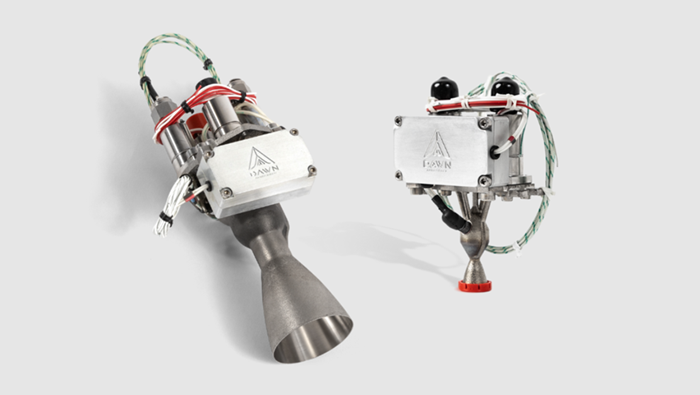
In spacecraft design, thrusters are tightly integrated with guidance, navigation, and control subsystems to deliver precise impulse bits and sustained thrust profiles as required by mission objectives. Their performance characteristics directly influence spacecraft mass budget, delta-v capability, power allocation, thermal management, and structural integration. Selection of spacecraft thrusters is therefore driven by propulsion efficiency, controllability, compatibility with the satellite platform, and the mechanical and electrical interfaces required for system-level integration.
Key specifications of Spacecraft Thruster
- Thruster Type: Thruster type defines the propulsion mechanism used to generate thrust, such as chemical, electric, or cold gas systems. This parameter determines propellant characteristics, required power input, achievable exhaust velocity, controllability, and system complexity. The selected type directly affects mission delta-v capability, operational lifetime, and integration constraints including power conditioning and thermal dissipation.
- Satellite Type: Satellite type indicates the class or mission profile of the spacecraft on which the thruster is deployed. Platform category influences propulsion architecture, redundancy philosophy, allowable mass and volume, and compatibility with onboard power and structural subsystems. Matching the thruster design to the satellite type ensures that performance, reliability, and environmental qualification align with mission-specific operational requirements.
- Thrust: Thrust represents the force produced by the thruster and determines the acceleration imparted to the spacecraft. It directly impacts maneuver duration, orbital transfer capability, and attitude correction responsiveness. Higher thrust levels enable rapid maneuvers but may introduce greater structural loads and plume interactions, while lower thrust systems support fine control and high-precision positioning.
- Thruster Mass: Thruster mass contributes to the overall spacecraft mass budget and affects launch vehicle compatibility and structural design. The propulsion subsystem mass includes the thruster assembly and associated mounting hardware. Lower mass improves payload fraction and system efficiency, while structural robustness and qualification margins must be maintained to withstand launch and operational loads.
- Specific Impulse: Specific impulse quantifies propulsion efficiency by relating thrust to propellant mass flow rate. It is a critical metric for evaluating propellant utilization and achievable delta-v for a given propellant mass. Higher specific impulse systems reduce propellant requirements but may impose greater demands on electrical power, thermal management, or system complexity.
- Thrust Noise: Thrust noise characterizes fluctuations in the generated force over time. Low thrust noise is essential for precision attitude control, formation flying, and missions requiring high pointing stability. Variations in thrust output can couple into structural modes and degrade control accuracy, making this parameter critical for high-stability and high-resolution payload operations.
- Interface: Interface defines the mechanical, electrical, fluidic, and communication connections between the thruster and the spacecraft. This includes mounting configuration, propellant feed interfaces, electrical power supply, command and telemetry lines, and thermal interfaces. Proper interface definition ensures compatibility with spacecraft subsystems, simplifies integration and testing, and supports reliable in-orbit operation.
The Largest Database of Spacecraft Thrusters
SatNow has listed Spacecraft Thrusters from the leading manufacturers and made them searchable by specification. You can enter the key parameters and the search tool will scan catalogs from the leading manufacturers to identify products that meet your spec. Once you find Spacecraft Thrusters that meet your requirement, you can view product information, download datasheets or request quotations. Quotation requests will be routed to the manufacturer of the product who will get back to you directly. The quotation will also be routed to distributors of the product in your region.
