60 Sun Sensors
from
24 Manufacturers
60 Products
from
24 Manufacturers
Page 1 of 4
What are Sun Sensors?
Sun Sensors are attitude determination devices that measure the direction of the Sun relative to the spacecraft body frame. They operate by detecting incident solar radiation on photodiodes or position-sensitive detectors and converting the measured light distribution into angular information. By computing the Sun vector, the sensor provides real-time orientation data that supports attitude acquisition, safe-mode stabilization, and coarse pointing operations.
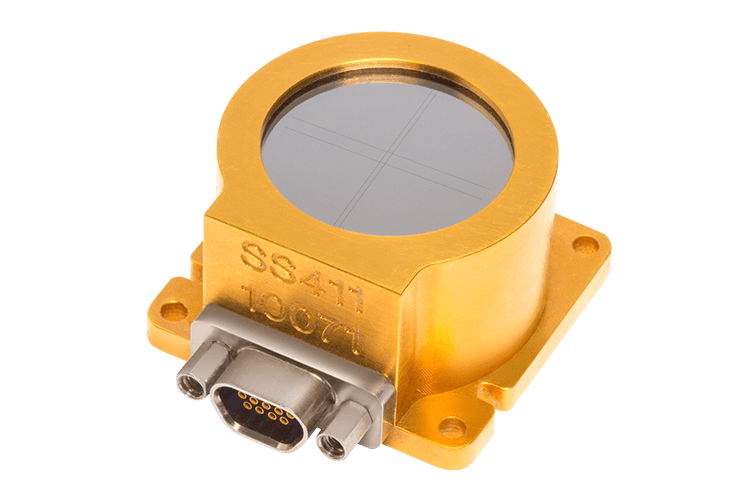
Within the spacecraft attitude determination and control subsystem, sun sensors are typically used for initial acquisition after separation, detumbling, solar array alignment, and as redundant references alongside star trackers and inertial sensors. Their performance depends on optical geometry, detector characteristics, signal processing electronics, and resistance to environmental effects such as radiation and temperature variation. Proper integration ensures accurate alignment with the spacecraft reference frame and reliable operation across mission phases.
Key specifications of Sun Sensor -
- Satellite Type: This parameter defines the spacecraft class and operational environment in which the sun sensor will be deployed. Satellite type influences mechanical integration, environmental qualification requirements, redundancy architecture, and control strategy. Mission objectives and orbit characteristics determine the required robustness, pointing performance, and operational duty cycle of the sensor.
- Types - This specification distinguishes between digital and analog implementations. Digital sun sensors incorporate onboard signal processing to provide discrete angular measurements or vector outputs via data interfaces, enabling direct integration with onboard computers. Analog sun sensors output continuous voltage signals proportional to incident light intensity, requiring external signal conditioning and processing. The choice impacts system architecture, processing load distribution, noise susceptibility, and interface complexity.
- Accuracy: Accuracy defines the angular deviation between the measured Sun vector and the true Sun direction. It directly affects spacecraft pointing performance, particularly during safe-mode operations and solar array alignment. Higher accuracy improves attitude estimation quality and reduces control error when the sun sensor is used as a primary or backup reference.
- Sun Field of View: Sun field of view specifies the angular region within which the sensor can reliably detect and measure the Sun’s position. This parameter determines operational coverage during spacecraft rotations and varying Sun incidence angles. Adequate field of view ensures continuous Sun acquisition and reduces the risk of signal loss during attitude maneuvers.
- Update Rate: Update rate refers to the frequency at which the sensor provides angular measurements or vector data. It influences control loop responsiveness and the ability to track dynamic attitude changes. Higher update rates support improved stabilization and faster convergence during detumbling or acquisition phases.
- Mass: The mass of the sun sensor affects spacecraft mass allocation and structural integration. Placement on external panels or booms requires consideration of launch loads, alignment stability, and thermal expansion effects. Mass optimization is particularly critical for small satellite platforms with strict resource constraints.
- Radiation Tolerance: Radiation tolerance defines the ability of the sensor’s photodetectors and electronics to withstand total ionizing dose and single-event effects in the intended orbit. Adequate tolerance ensures long-term measurement stability, prevents degradation of detector sensitivity, and maintains reliable operation throughout the mission lifetime.
- Supply Voltage: Supply voltage specifies the required electrical input for the sensor’s detection and processing circuitry. Compatibility with the spacecraft power distribution system is essential to ensure stable operation. Voltage stability influences signal integrity, measurement consistency, and overall reliability.
- Interface: The interface parameter includes mechanical mounting provisions, electrical power connections, signal or data outputs, and thermal coupling. Mechanical alignment accuracy directly affects angular measurement fidelity, while electrical and communication interfaces must integrate seamlessly with onboard processing units. Proper interface definition ensures dependable integration within the spacecraft’s attitude determination and control subsystem.
The Largest Database of Sun Sensors
SatNow has listed Sun Sensors from the leading manufacturers and made them searchable by specification. You can enter the key parameters and the search tool will scan catalogs from the leading manufacturers to identify products that meet your spec. Once you find Sun Sensors that meet your requirement, you can view product information, download datasheets or request quotations. Quotation requests will be routed to the manufacturer of the product who will get back to you directly. The quotation will also be routed to distributors of the product in your region.
